Can You Forecast a Currency?
Testing whether inflation explains the USD/CAD rate, then forecasting it with ARIMA.
The Problem
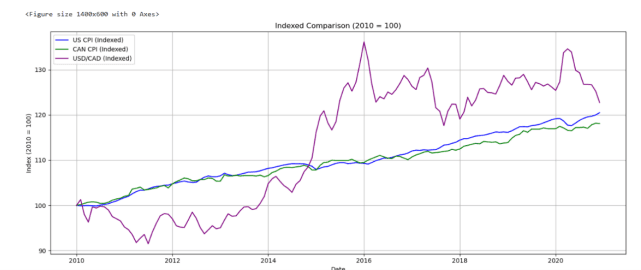
A famous economic theory, Purchasing Power Parity, says exchange rates should follow inflation differences between countries. Sounds neat. Does it survive contact with real data? We pulled 11 years of monthly US/Canada data from the Federal Reserve and put the theory on trial.
The Approach
- 1
Get clean data
Monthly USD/CAD exchange rates and consumer price indices for both countries, 2010–2020, from the Federal Reserve's official database. 132 months, zero missing values.
- 2
Test the theory
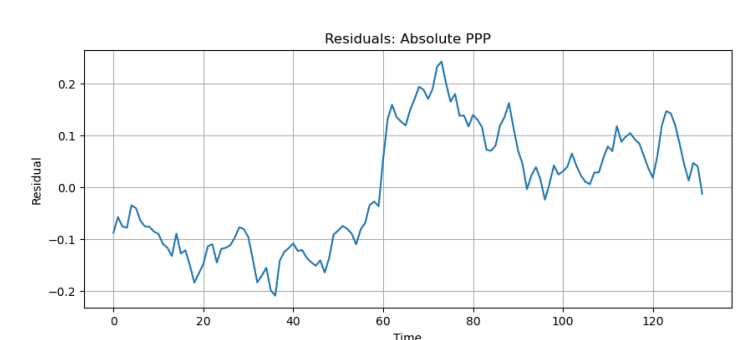
Regression of exchange rates against inflation differences. Long-run version: weak (18% explained). Short-run: no statistically significant effect at all. Conclusion: inflation alone doesn't drive this currency pair.
- 3
Prepare the series properly
Checked whether the data was stable enough to model (it wasn't), and transformed it until it was, the unglamorous step that makes or breaks time-series forecasting.
- 4
Compare six models, forecast with the best
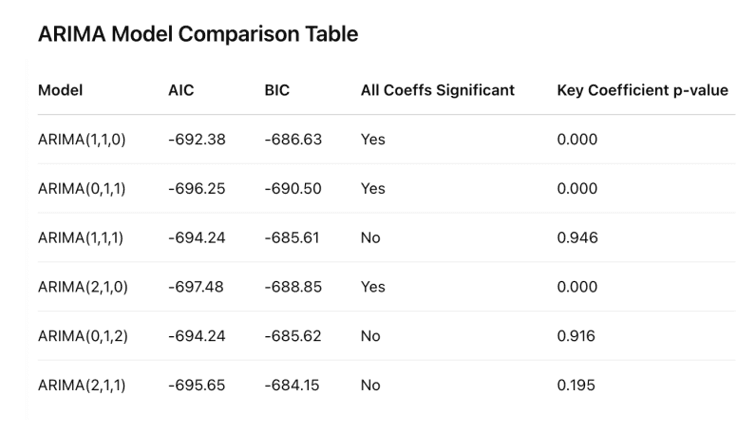
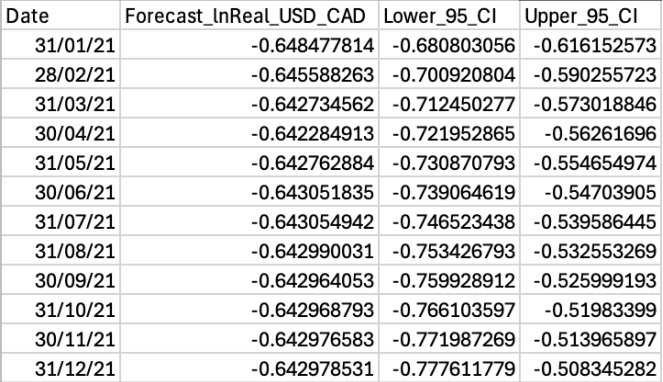
Scored six ARIMA variants on fit, simplicity, and whether their errors looked random. The winner used the past two months of movement to predict the next, and produced a stable 12-month forecast with a 95% confidence range.
The Evidence
The Outcome
months of central-bank data analysed
how little of the rate inflation explains
forecasting models compared before choosing one
Seen enough?
Let's talk